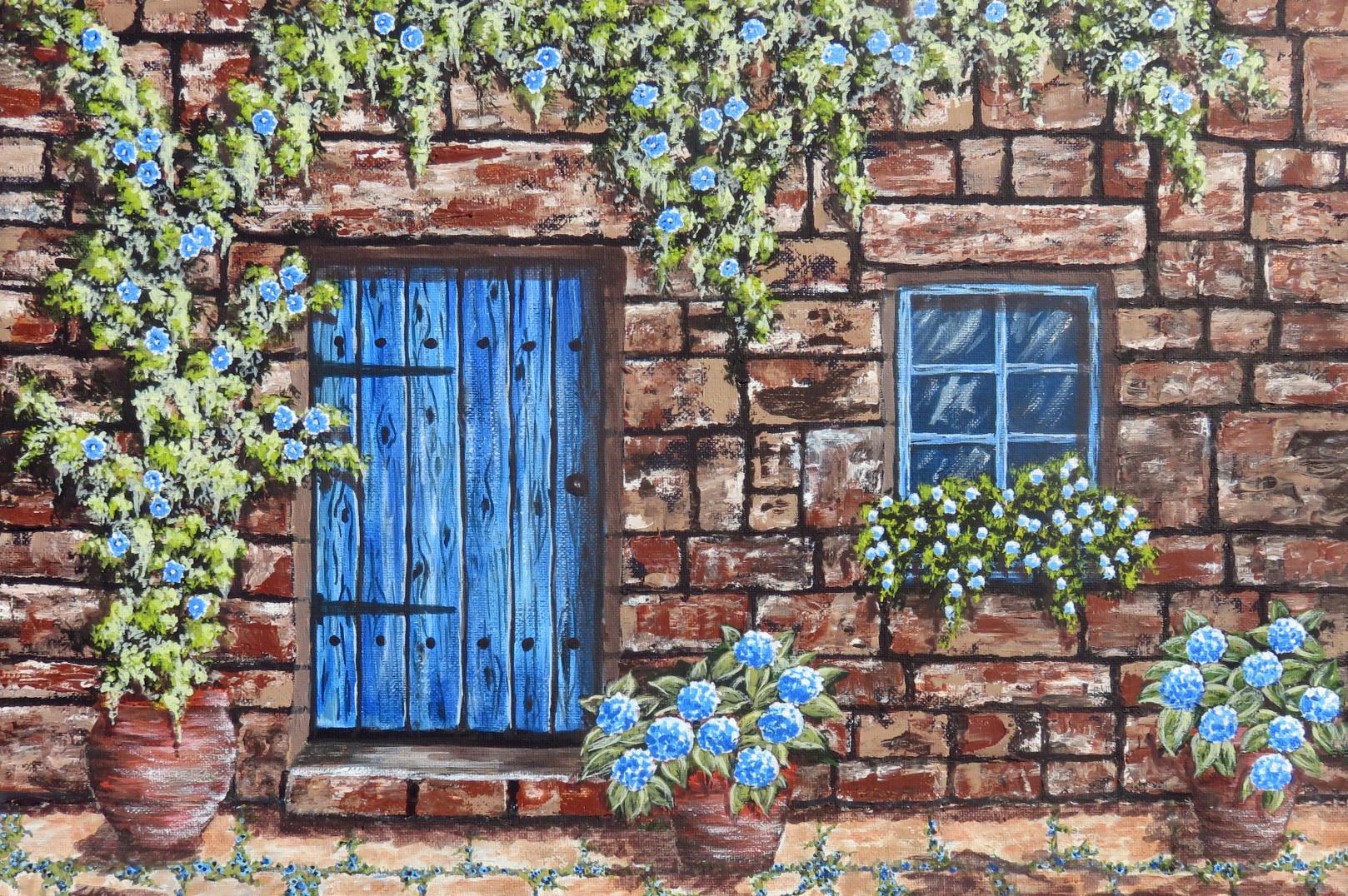
The color blue is rare in nature. It is much easier for plants and animals to make other colors — there are far more chemicals that are red or yellow or pink or green, than are blue. Of course, some animals still manage to be blue, but they have to use a trick. Rather than make blue pigments, which are very difficult to synthesize, they are structurally blue. This means they are blue because of the way light reflects off of them. If you crush up a bluebird’s feathers, a hydrangea’s petals, or a butterfly’s wings and try to paint with those colors, the blue would be all gone, because you destroyed the structure.
There is, however, one one place in the world, where blue pigments are found in abundance: the city of the blue flower. People from all over the world would visit that city. Merchants would buy the beautiful blue color to sell far and wide. Zoologists would come to study the unique blue creatures that thrived upon the flower. Romantics and poets would come to fall in love with the beautiful people who adorned themselves with the flower, who ate it and turned their own skin a beautiful dark blue. And artists would come to make blue paints and paint the most elegant city in the world.
Of course, many people had tried to take the flowers from that city and plant them in their own villages, so as to capture a little bit of the city’s splendor. Unfortunately, almost as soon as the buds were placed in foreign ground, they died. The city was situated at the mouth of a river, and was one of the few places where the minerals needed to form the pigment and the nutrients needed to feed the flower coexisted. In nearby towns, they slowly lost their color and wilted. Farther still, and the tropical climate which sustained the plants — each sunny day followed by a downpour, and each downpour followed by a sunny day, and each as beautiful as the flowers — that tropical climate faded, and the flowers saw a swifter end.
The fact that these flowers could only grow in their native land conferred many advantages upon the city, and many people who tried to take the flower and grow it elsewhere grew resentful. Eventually, one of the kings of that kingdom was incensed that he could not bring the blue flower back to the capital. Seeing that his city could not have the flower’s beauty, he decided that no city should have the flower’s beauty.
He sent his soldiers to salt the earth, dam the water, and cover the fields in ice and snow from the north. The people of the city pleaded with him, but to no avail. He was bent on destroying the flower, and his word was the law. The land wilted under his thumb.
Still, the people of the city would not give up so easily. Even as their city and their flower died around them, they managed to save eight of the flowers from destruction. They quietly nurtured them, saving them for the day that the king’s soldiers would leave. A year later, the king withdrew his troops. The land had been decimated, and the blue flower removed. But the city was quick to action. They began re-cultivating the flower, and with it they re-grew hope in the city. A measure of prosperity returned, and the people were happy.
The king was not. He fumed in his palace, at the insolence he saw unfolding. Gathering his troops, he moved to nip the flower in the bud. When he returned to the city, he made sure not just to crush the flowers, but also the people. He was horrific and decisive in his action, and he made sure that the people would not disobey him again.
Still, the people of the city would not give up so easily. Although the king had been more thorough, combing through the city to eliminate every last floret, one flower had slipped through his fingers. The city council decided to plant the flower in the house of the oldest man in the city. He was an expert botanist, having cared for the flowers the longest of any person in the city. His house was a shanty, and the soil under his house was one of the few patches of ground that remained untouched. His house was in the middle of the city, lost among the throng, so that it was nigh impossible to find. But, perhaps most important of all, he was a man of honesty and resolve. It would be easy for most people to sell that final flower and make a handsome profit, or, fearing for their lives, to turn that flower in to the king. But that old man was not the kind to give in to temptation.
That man and his family toiled, day after day, year after year, to keep that flower healthy. Each year, they collected its seeds, keeping them carefully. And they waited. For years and years, they waited. For the land to recover. For the people to forget the King’s wrath. For the king to die.
And finally, the king did die, replaced by a far fairer monarch, and the old man distributed the seeds he had gathered among all the people of the city. That one flower became many, and the city once again became the city of the blue flower.
To this day, the people respect that old man and his family, for he kept that single, fragile blue flame of hope alive. A man of his care is just as rare as a pigment of color blue.
 Two Brothers Write